Kiwi Translocation
On Saturday 18th March a team of experienced kiwi handlers headed out to Motuora to catch 10 kiwi as the first of 3 translocations to Tamahunga. Four female and 7 male kiwi were captured through a long night. The first few kiwi were quickly caught as they were conveniently resting in penguin boxes. The rest of the kiwi lead the catch team on a merry chase until the wee small hours of Sunday morning. One of the males caught, now microchipped and named Rarangi, was left on the island. During his health check he was found to have a slightly damaged beak, so the decision was made to leave him in a familiar environment as he was healthy and doing well where he was. The other 10 kiwi were all fit and healthy, so were microchipped, named and transmitters attached before being boxed up ready for transfer.

Photos of the 2023 kiwi translocation catch team. The photo top right shows the beack being measured, as part of the health check and to determine kiwi gender. The photo bottom right shows a transmitter being attached to allow tracking of the kiwi.

Photos of Tamahunga Trappers and helpers returning kiwi to Tamahunga in March 2023.
After transfer by boat from Motuora to Sandspit on the morning of Sunday 19th March, the kiwi were welcomed with a karakia by a kaumātua from Ngāti Manuhiri. The birds were then taken by 5 release teams, led by experienced kiwi handlers, to be released at several sites within the Tamahunga forest. Four kiwi were flown to the summit of Tamahunga by Skyworks Helicopters.
On the day, it took the efforts of almost 50 people, a boat and a helicopter to transport the kiwi to their new home on Tamahunga.

Photos of Tamahunga Trappers team members, under the watchful eyes of kiwi acredited handlers, holding kiwi just before popping them into a temporary burrow box, March 2023.
The kiwi are now being closely monitored by the Tamahunga Trappers telemetry team as they settle into their new home. They have been moving about the forest, exploring their new home. Early on, one of the males headed off on an expedition, all the way to Pakiri! Due to the threats present outside the protected forest, this bird was quickly tracked down, caught and returned to Tamahunga.

Photos from the capture and return to Tamahunga of the male kiwi that went for a 7km wander away from Tamahunga, March 2023.

Photos from the 8-week post release health checks, May 2023.
At 8-weeks post-release, all the kiwi needed to be recaptured. This is to check that they have settled well into their new home. The transmitter is also swapped from one leg to the other.
The kiwi have scattered over the maunga, and some seem to be pairing up. Fingers are crossed that soon the telemetry team will start to pick up egg-timer signals from the male kiwi - indicating that they are incubating an egg.
The kiwi have scattered over the maunga, and some seem to be pairing up. Fingers are crossed that soon the telemetry team will start to pick up egg-timer signals from the male kiwi - indicating that they are incubating an egg.
Dogs are a big threat to kiwi
In the wild, kiwi can live more than 50 years. Unfortunately because of dogs, the average adult kiwi life expectancy is 13 years. It’s not just feral dogs or lost hunting dogs who kill kiwi.
60% of known kiwi deaths are caused by dogs.
Any dog, whatever size or breed, despite being well trained, will kill a kiwi, if given the chance. That’s because dogs can’t resist the strong smell of kiwi! An adult kiwi may try to fight back, but that will only excite a dog even more.A dog can catch and kill a kiwi in seconds.
Kiwi can NOT defend themselves.
Kiwi do not have a breast bone, and because they don’t fly, there are no strong muscles to protect its chest which will crush easily in a dog’s mouth. Even if it survives an attack, it will probably die later from the injuries and infection.Once a dog gets a ‘taste’ for kiwi, it’s very likely to want to hunt more. The excitement of the kill is too great.
What can you do?
- Make sure dogs never go where kiwi live.
- Keep your dog under control: tied up, in an enclosure, or on a lead.
- Don’t let dogs ‘free range’ to catch possums.
- Make sure your dog is well trained, responds quickly to your commands.
- If you find a kiwi that’s been attacked by a dog, act fast – take it to a vet or the Department of Conservation straight away.
- Sign your dog up for kiwi aversion training if you live near to a kiwi population.

A kiwi killed by a dog. Photo: Department of Conservation.
North Island Brown Kiwi
For many New Zealanders, brown kiwi is the species we think about when kiwi are talked about. They live closest to human habitation and is the main species on display in captivity. The proximity to people has also created risks to these iconic birds through increased contact with dogs, cats and cars. However, it has also been a great advantage to the recovery of the species – hours and hours of effort from community initiatives in habitat restoration benefit brown kiwi populations at many locations, including Tamahunga.
The brown kiwi is faster breeding than other kiwi, producing up to two eggs a clutch, and one or two clutches per year. As opposed to the more usual one egg per year for other kiwi species. However, that reproductive work is undone by the ravages of dogs, stoats and the loss of habitat.
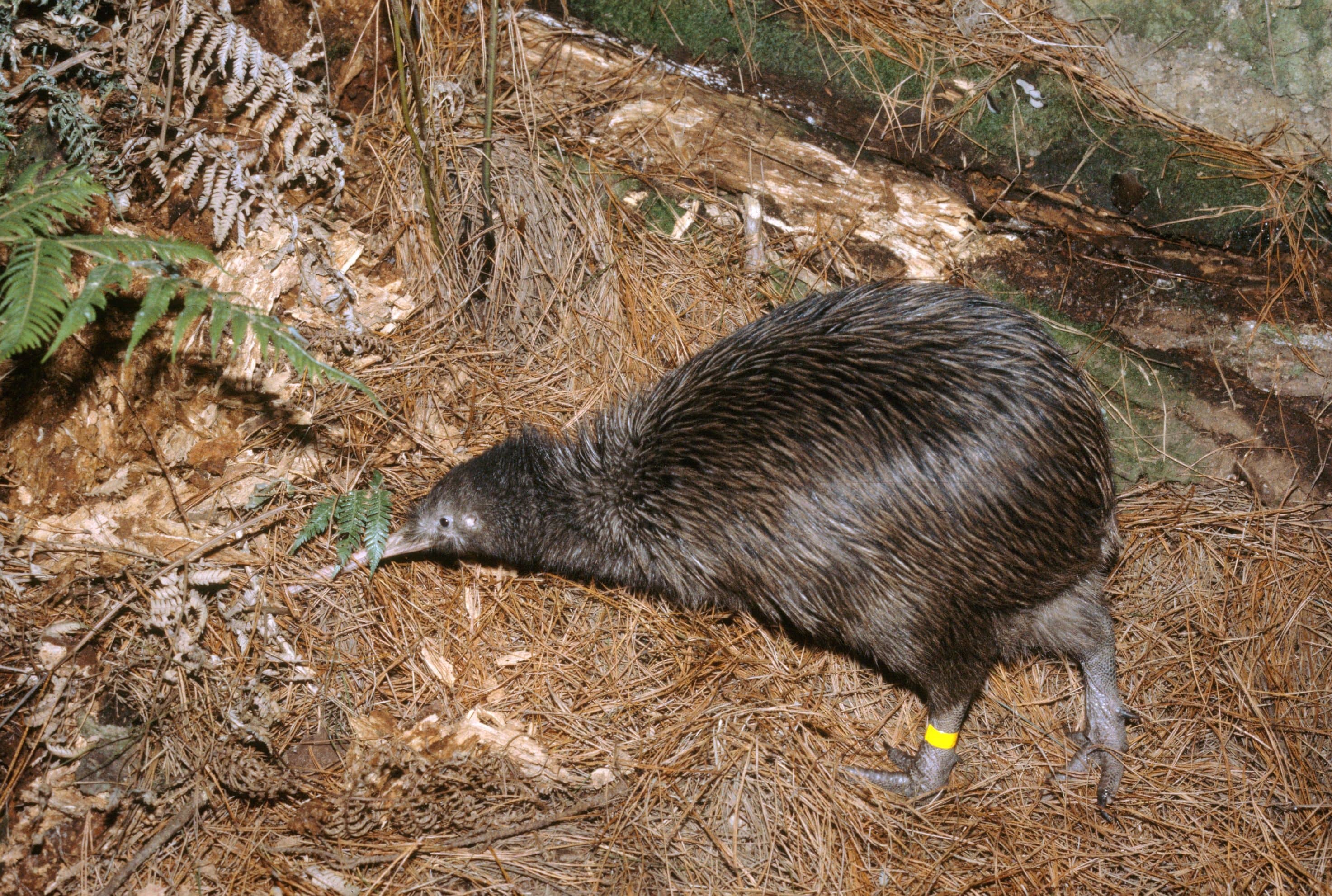
Photo: Department of Conservation.

Photo: Department of Conservation.
Kiwi generally have multiple daytime shelters, including burrows, fallen nikau fronds, hollow logs, tight vegetation and slash from forest harvest and land clearing. They may also roost on the edge of roads or bush. They can be found running around roads at night and through properties.
Adults are territorial and will stay in an area as long as habitat is suitable. Their territory will usually overlap with that of their mate. Territories are maintained through calling, although fights ensue if enforcement is needed! Territory location is important for kiwi as they lose condition without ready access to water.


Photos: TOP - Tamahunga Trapper Chair, Dave Wilson holding a North Island Brown Kiwi. BOTTOM - Tamahunga Trapper, Sue Cameron attaching a transmitter to a kiwi. These were taken courtesy of Kaipara Kiwi who are helping the Tamahunga Trappers with their kiwi handling training.
In 2014, the Tamahunga Trappers were advised by the Department of Conservation (DOC) that our trapping programme on the maunga was intensive enough for the return of North Island brown kiwi. With the support of local iwi, Ngāti Manuhiri, we made an application to DOC for a kiwi translocation.
On further consideration and following advice from DOC, this application was withdrawn... for the time being... for two reasons:
- monitoring the kiwi on Tamahunga after their release was going to be difficult, due to the steep terrain.
- difficulty protecting the kiwi from dogs, particularly as subdivision and development on the northern side of the maunga would likely lead to an increase in dog numbers.
However, five years later, two developments made us think that we could overcome the obstacles to monitoring the birds and protecting them from dogs:
- An influx of new volunteer Trappers has provided us with a wide range of skilled people to to carry out telemetry monitoring of the kiwi.
- Tamahunga Trappers now have the support and partnership of the Forest Bridge Trust, which is enabling us, amongst other things, to find resources to develop and implement a robust plan for working with local dog owners.


Making the kiwi feel at home on release day
Rather that dig holes to release the kiwi into, an easier option is to provide a wooden 'burrow' box. These boxes are a temporary home so the kiwi have a safe, dark place to relax in after they are released.
As soon as night falls, the kiwi will leave the 'burrow' box and venture into the bush to feed and find their own special hidey-hole.
We had a fun day out with a big group of Trappers to carry in the boxes for our 2023 translocation.
Photos, clockwise from top right - a Kiwi in a kiwi box; a couple of our younger Trappers carrying a burrow box up to the bush; a Trapper with burrow boxes on his back.